
Tailor your CV for different jobs by starting with one strong master CV, then adjusting the parts that matter most for each application. A generic CV often misses the mark because recruiters and hiring systems are looking for relevance, not just experience. When you tailor your CV for each job, you make it easier for employers to see why your background fits their role, without rewriting your entire document every time.
Table of Contents
Many job seekers assume the only way to improve applications is to start from scratch every time. In reality, how to tailor a CV is less about rewriting and more about refining. This works especially well when your foundation is already strong, which is why a proper CV optimisation service can make future applications much easier to manage.
Why a static CV often underperforms
A static CV can be accurate and still be too broad. Hiring teams usually review applications against a specific brief, and many employers use Applicant Tracking Systems to scan for relevant language, skills, and experience before a human reviews the file. When your CV stays generic, it can fail to highlight the parts of your background that matter most for the role.
This does not mean stuffing your CV with copied phrases. It means improving alignment. If one role values client communication, another values reporting accuracy, and another values team leadership, your CV should make the most relevant strengths easier to spot. That is the difference between a document that lists your history and one that supports a specific application.
For many job seekers, this is also where frustration starts. They know they have the right experience, but the CV does not clearly connect that experience to the role they want. If that sounds familiar, it helps to first understand what is CV optimisation and why relevance matters so much in the current hiring process.
Start with a master CV, not a blank page
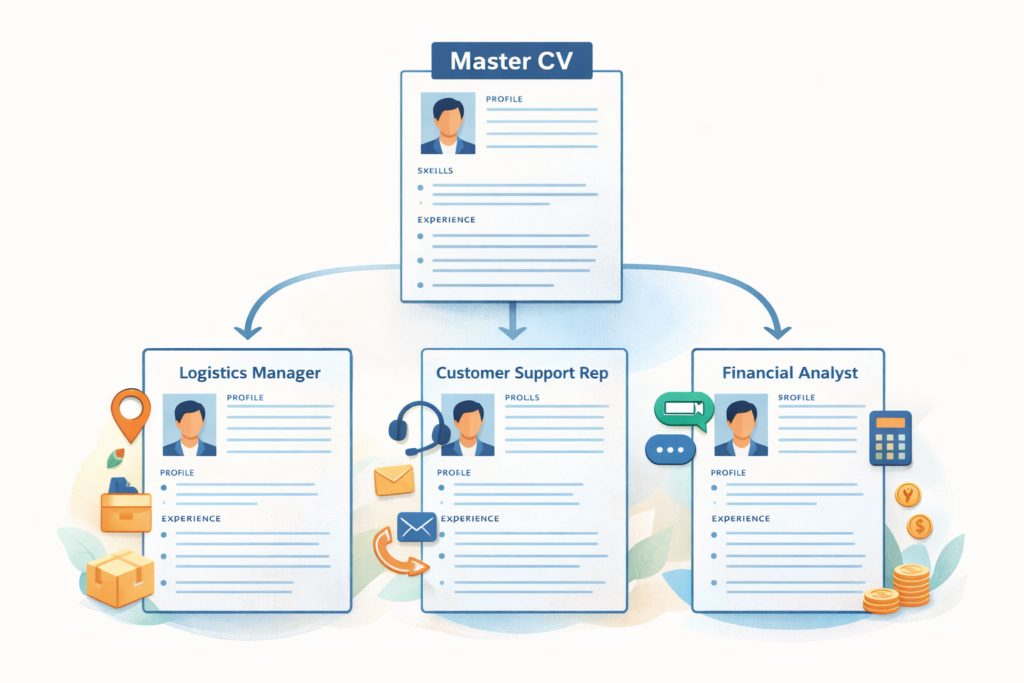
The most sustainable way to tailor your CV for different jobs is to build one detailed master CV first. This document should contain your full work history, core achievements, skills, qualifications, tools, certifications, and strong bullet points you can reuse. Once that base exists, tailoring becomes much faster.
Your master CV is not the version you send everywhere. It is your source document. Think of it as the place where you keep the full picture of your career. From there, you create a sharper version for each application by changing emphasis, wording, and section relevance.
This approach also protects quality. Instead of making rushed edits to the same file over and over, you keep your strongest content in one place and adapt it with more control. That reduces errors, inconsistency, and last-minute formatting problems.
What should stay the same in your CV
Not every part of your CV needs to change. Your name, contact details, qualifications, employers, dates, and factual experience should remain stable. The aim is not to create a new identity for every job. The aim is to present the same experience in the most relevant way for the target role.
Your overall formatting should also stay consistent. Clear section headings, readable layout, simple structure, and clean bullet points support recruiter readability and ATS processing. This is also why an ATS-friendly CV needs more than just the right keywords. A strong ATS-friendly CV also needs structure, relevance, and clarity.
A stable foundation matters because tailoring works best when the document is already strong. If the base CV is cluttered, vague, or poorly structured, changing keywords alone will not solve the problem.
What to tailor for each application
1. Your headline or top positioning
The top of your CV should quickly tell the reader what kind of role you are targeting. A generic line such as “hardworking professional” says very little. A more tailored headline signals direction, for example operations coordinator, customer support specialist, or junior financial administrator, depending on the role.
2. Your professional summary
Your summary is one of the easiest places to tailor your CV for different jobs. It should reflect the kind of experience, strengths, and priorities that match the job advert. You do not need to rewrite your entire background. You only need to bring the most relevant parts forward.
3. Your key skills section
If a job description repeats certain tools, capabilities, or responsibilities, your skills section should reflect those where they are genuinely true for you. That helps the document speak the same language as the role without sounding forced.
4. Your experience bullets
This is often the biggest opportunity. You do not need to replace every bullet point. Instead, reorder or refine them so the most relevant evidence appears first. If the job needs stakeholder communication, reporting, or process improvement, make sure those examples are visible.
5. Optional supporting sections
Depending on the role, you may also need to adjust certifications, software tools, projects, languages, or industry-specific knowledge. These smaller edits can strengthen fit without changing the core story of your experience.
How to use the job advert properly
A job advert is not only a list of duties. It is a map of what the employer values most. Start by reading it slowly and marking repeated themes. Look for skills, systems, outcomes, and responsibilities that appear more than once or appear near the top. Those are often clues about what should be emphasised in your CV.
Next, separate the advert into categories:
- required skills
- preferred skills
- tools or systems
- level of responsibility
- outcomes expected in the role
This makes it easier to compare the advert with your master CV and spot where your current version is too generic.
Then match, do not mimic. Use the employer’s language where it truthfully reflects your experience, but avoid copying blocks of text into your CV. Recruiters can usually see when wording has been pasted in without evidence behind it. A better approach is to tailor CV to job description requirements honestly, using your own experience as proof.
A simple process to tailor your CV for different jobs
Step 1: Keep one master CV
Maintain a complete version with all your strong content. This is where you store better bullet points, quantified achievements, platform knowledge, and role-specific wording you may reuse later.
Step 2: Choose one target role
Before editing, get clear on the specific role you are applying for. Tailoring works best when the target is clear. A CV for a customer service role and a CV for an operations support role may overlap, but the emphasis should not be identical.
Step 3: Highlight the top keywords and priorities
Review the job description and note the language that appears important. This may include skills, systems, responsibilities, or outcomes. Focus on the words that reflect actual requirements, not generic company slogans.
Step 4: Update your summary and skills
Adjust your top section first. This gives the reader a quick sense that your CV was prepared for this kind of opportunity and not sent blindly to dozens of employers. This is one of the clearest answers to the question of how to tailor a CV without making the process too complicated.
Step 5: Reorder and refine your experience bullets
Move the most relevant bullet points higher. Strengthen weak bullets with action and outcome. Where possible, show impact with numbers, improvements, or scope. Tailoring is often more about selection and emphasis than full rewriting.
Step 6: Review for consistency
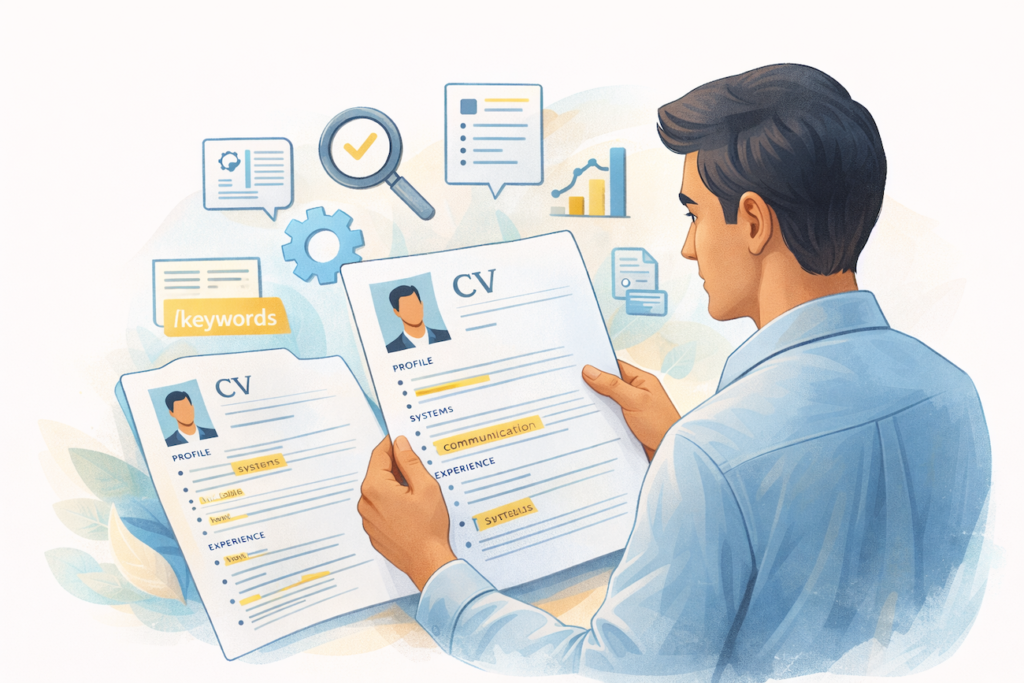
Check that the summary, skills, and experience sections support the same target role. Then proofread the final version carefully. A tailored CV still needs to feel natural, credible, and clean.
Example of light tailoring without rewriting everything
Imagine you have one master CV and you are applying for two roles.
For a customer support role, you may lead with client communication, complaint handling, CRM tools, response times, and service quality. For an operations support role, you may lead with reporting, process coordination, data accuracy, scheduling, and admin systems. The employers may be looking at the same person, but they are evaluating different strengths.
Your employer names, dates, and core responsibilities stay the same. What changes is the order, emphasis, and wording of the content that proves fit. That is why tailoring can be efficient when the base CV is already strong.
This is also where many job seekers learn how to customise CV for job application needs without losing consistency. The key is not to create a different story each time. The key is to present the same story in the most relevant way.
Checklist: tailor your CV for different jobs before you apply
Use this checklist before sending any application:
- Does the top of the CV clearly reflect the target role?
- Does the summary match the role’s main priorities?
- Have you used relevant keywords from the job advert honestly and naturally?
- Are the most relevant skills easy to spot?
- Have you moved the strongest matching achievements higher in the experience section?
- Does the wording stay accurate to your real experience?
- Is the formatting still clean and readable?
- Have you removed details that distract from the target role?
- Have you checked spelling, grammar, and consistency?
- Does the CV still sound like one coherent professional profile?
Common mistakes when tailoring a CV
Copying the job advert word for word
This is one of the fastest ways to make a CV feel artificial. Use relevant language, but back it up with actual examples from your experience.
Tailoring only the skills section
Many job seekers add a few keywords at the top but leave the experience section unchanged. The stronger move is to align the evidence in your bullet points with the role’s priorities.
Rewriting too much each time
If you are rebuilding the entire CV for every application, the process becomes slow and inconsistent. That is usually a sign that your master CV is not strong enough yet.
Using keywords without proof
Adding terms that do not reflect your real experience may help you sound relevant briefly, but it creates problems later in screening or interviews. Tailoring should improve clarity, not create risk.
Ignoring LinkedIn alignment
Your CV and LinkedIn profile do not need to be identical, but they should support the same professional direction. If your documents are sending mixed messages, it may be worth reviewing your LinkedIn optimisation approach at the same time as your CV.
When you may need more than tailoring
Sometimes the problem is not tailoring. It is the base document itself. If your CV has weak structure, vague summaries, duty-heavy bullet points, inconsistent formatting, or no clear target direction, tailoring alone will not fix the underlying issue.
That is usually the point where a full rewrite or professional optimisation becomes more useful than small edits. A better base CV makes every future application easier to tailor. For some job seekers, this also connects to broader personal branding and career identity work, especially when the issue is not only the CV, but the way their professional value is being communicated overall.
How Virtual Focus can help
Virtual Focus helps job seekers improve how their experience is presented, structured, and understood by both recruiters and hiring systems. The service positioning already focuses on CV rewriting, keyword alignment, recruiter readability, and LinkedIn support, which fits naturally with the challenge of tailoring applications more effectively. You can explore the main CV optimisation service to see how this support fits into a broader career positioning process.
If you already have experience but your applications still feel too broad, the right support can help you build a stronger master CV first. Once that foundation is in place, you can tailor your CV for each job more efficiently and customise CV for job application requirements with far more confidence.
FAQ: How to Tailor Your CV for Different Jobs
Do I need a different CV for every job?
Not completely. In most cases, you need one strong master CV and a tailored version for each role that changes the summary, skills emphasis, and most relevant experience points.
How much should I tailor my CV?
Tailor enough that the target role is obvious. Focus on the top section, keywords, and experience bullets rather than rewriting every line.
Can I use the same CV for similar roles?
Yes, but similar roles still have different priorities. Even small adjustments can improve relevance and readability.
Will tailoring help with ATS?
It can. Tailoring helps when you use relevant keywords and structure clearly, especially when those terms reflect real experience shown in the body of the CV. That is also why understanding an ATS-friendly CV matters.
Final thought
To tailor your CV for different jobs, you do not need to start over every time. You need a solid master CV, a clear target role, and a smarter editing process. When you focus on relevance instead of volume, your CV becomes easier for recruiters to scan and easier for hiring systems to understand.
Once you learn how to tailor a CV, the process becomes much more practical. You can tailor CV to job description requirements in a focused way, customise CV for job application needs without losing consistency, and tailor your CV for each job without rewriting everything from scratch.
If your current CV still feels too generic, too broad, or too difficult to adapt, this is usually a sign that the base document needs stronger positioning first. Once that is fixed, tailoring becomes far more manageable.